Short answer
Once police release a home, families are often free to clean it themselves, but the critical differences favor professionals. Trained crews find material that traveled beyond the obvious area, remove what soaked into flooring and walls, disinfect correctly, manage regulated waste and produce records for insurers and victim compensation. Most importantly, they spare you prolonged contact with the place your loved one was killed. There are safer ways to help.
Why families consider doing it themselves
Some families are surprised to learn that after police release a home, the responsibility for cleanup falls to the property owner or family, not to the police or the medical examiner. That news can arrive at the worst possible moment, often with little guidance.
Faced with that, people reach for what they can do. A brother might want to spare his parents from seeing the room. A spouse might not want strangers in the house. A family might fear the cost. Others simply feel that caring for the space is one last way to care for the person they lost.
Those feelings deserve respect. This article sets out the practical differences between doing it yourself and hiring a trained crew, so you can make the choice with clear eyes.
Could cleaning affect the investigation or a future trial?
Before release, cleaning is not an option. Investigators and the medical examiner need the scene intact, and disturbing it can compromise evidence. After release, the scene is yours again, but homicide cases often continue for months or years through charging decisions and court proceedings.
Before discarding anything that seems significant, such as a damaged item, a phone or a piece of furniture, it is reasonable to check with the detective or prosecutor's office. They will usually have already collected what they need, but asking protects you and the case. A professional provider is used to these questions and can set questionable items aside until you have an answer.
Keeping clear records of what was removed, cleaned and disposed of can also help if questions arise later.
Health risks: pathogens, sharps and chemicals
Blood can carry bloodborne pathogens such as hepatitis B, hepatitis C and HIV, and dried blood remains a hazard. Scrubbing, vacuuming or pulling up carpet can release particles. Trained technicians follow universal precautions and wear fluid-resistant suits, eye protection, doubled gloves and respirators, and they work within a bloodborne pathogens program that includes training and vaccination.
Homicide scenes also bring physical hazards. Broken glass, damaged furniture and splintered wood can cut through household gloves. Heavy items such as mattresses and couches can cause injuries when moved by untrained people in a small space.
Household chemicals add risk. Mixing bleach with ammonia or acidic cleaners releases toxic gases. Harsh products can damage floors and finishes while still failing to disinfect a surface that was not cleaned first.
If someone has already started
If a family member has already started, stop the work, wash exposed skin with soap and water and bag any cloths, sponges or tools that touched the area. If anyone was cut or splashed in the eyes or mouth, call a doctor or urgent care clinic promptly and explain what happened. There is no shame in this. Many families begin before they know the risks.
Why is the visible area not the whole scene?
Homicide scenes rarely stay in one place. Fine droplets can reach ceilings, fans, blinds and the backs of furniture. People moving through afterward, including responders who were trying to help, can carry traces along hallways, stairs, entryways and outside steps. If the home was held for several days, fluid may have soaked through carpet into pad and subfloor or wicked into the bottom of drywall.
A family member cleaning with a flashlight and sponge will usually address the obvious area and miss the rest. The result may look acceptable until odor develops or a stain reappears along a floor seam.
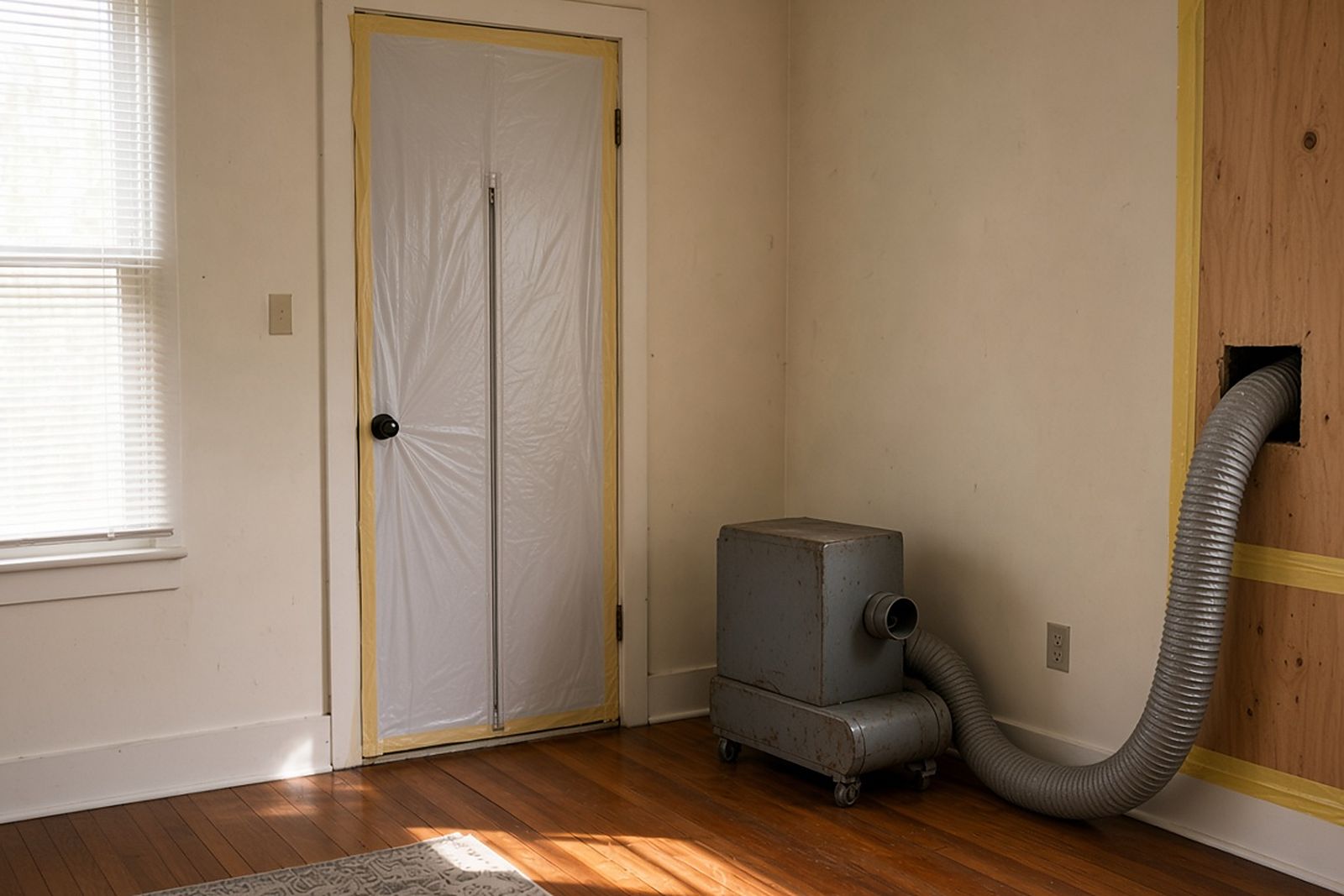
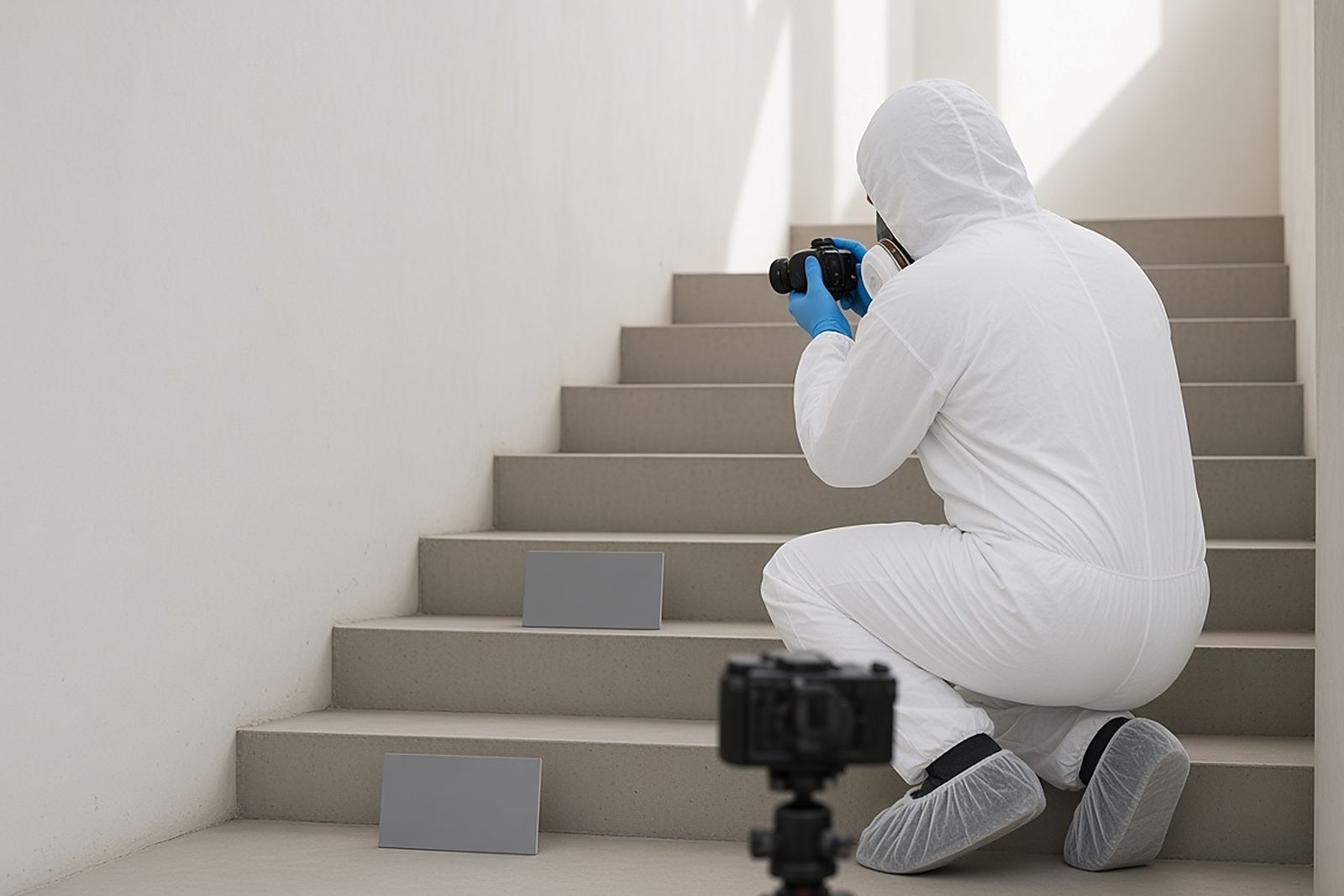
Professionals inspect with bright, angled light, lift flooring where needed and follow a sequence: remove bulk material, clean with detergents or enzyme products, then apply an EPA-registered disinfectant for the full contact time listed on its label.
Investigation residue adds to the job. Fingerprint powder and adhesive from evidence tape may appear on doors, windows and furniture in rooms that were otherwise untouched. Wiping powder with a wet cloth tends to smear it into a gray film, especially on textured paint and grout, which makes removal harder.
- Ceilings, light fixtures and fans
- Undersides and backs of furniture
- Carpet pad, subfloor and floor seams
- Baseboards and the lower edge of drywall
- Hallways, stairways, entryways and vehicles
Regulated waste and household trash
Materials soaked with blood are generally handled as regulated waste in professional work. They are sealed in labeled containers and taken to a permitted facility, with records. Placing them in household trash can put sanitation workers at risk and may conflict with local requirements. Your county health department's environmental health office can tell you what applies to household disposal where you live.
Paperwork: what insurers and compensation programs want
Paperwork matters more in homicide cases than many families expect. Insurers may want photos, itemized invoices and a description of what was removed. State victim compensation programs frequently reimburse some crime scene cleanup costs for eligible families, but they require documentation. A professional provider produces this as part of the job. A DIY effort usually leaves you with receipts for cleaning supplies and little else.
Before deciding that cost rules out professional help, speak with a victim advocate at the police department or prosecutor's office. They can explain what programs exist in your state and how to apply.
What is the emotional cost of doing it yourself?
This may be the most important difference of all. Cleaning the place where your loved one was killed means hours of close contact with the physical reality of their death. Families who have done it often describe images that stayed with them long afterward.
Homicide loss already carries a heavy emotional load. In a national survey of 206 immediate family members of homicide victims, published by the National Institute of Justice in 1991 from research by Amick-McMullan, Kilpatrick and Resnick, 23.3% developed PTSD at some point in their lives. Adding the work of cleaning the scene can make that burden heavier.
Trained technicians do this work with protective equipment, a plan and support of their own. Letting them take it on is not avoidance or weakness. It is a way to protect your memory of the person, not just your health.
One family, two paths
The following sketch is illustrative, not a real case. A woman is killed in the kitchen of her home. After police release the house, her adult son decides to clean it himself so his younger siblings will not have to see anything.
He spends an evening scrubbing the tile floor and cabinet fronts, throws the kitchen rug and some towels into the trash and mops the hallway. The room looks clean. Over the next week, a faint odor develops near the refrigerator and the dining room carpet at the edge of the hallway darkens along a path.
The family calls a professional provider. The technician finds material that had run beneath the refrigerator and dishwasher toe kicks, droplets on the underside of the kitchen table and traces tracked onto the dining room carpet and pad. The crew moves the appliances, cleans and disinfects beneath them, removes the affected carpet and pad and documents everything for the family's victim compensation claim.
The son later tells a counselor that the evening he spent cleaning is one of his hardest memories of that time. The family is invented, but the pattern reflects experiences families commonly describe.
Choosing a professional you can trust
Look for a provider who explains the process calmly, gives you a written scope after an on-site assessment and names the products they will use. Ask how they handle personal items, how they document their work and how waste will be transported. Ask whether they have worked with victim compensation programs in your state.
A respectful provider will not pressure you, will not ask for graphic details on the phone and will offer to speak with a family member or advocate on your behalf. Discretion matters too, such as unmarked vehicles and plain clothing on arrival.
It is fine to call more than one company and compare. A good provider will understand that you are making an important decision during a painful time, and will give you space to think without offering pressure or limited-time pricing.
What can you do instead that genuinely helps?
There are many safe ways to care for the home and your family. Keep the affected area closed off and keep children and pets away. Make a list of belongings you want saved, such as photographs, jewelry, papers or items with cultural or religious meaning. Gather the police report number and your insurance details. Choose one family member to be the point of contact with the provider.
Most of all, give yourself room to grieve. Many police departments and prosecutors' offices have victim advocates who can connect you with homicide survivor groups, counseling and practical help. Accepting that help is a strength, and it lets you spend your energy where it matters most.