Short answer
OSHA standards apply to the company doing homicide cleanup, not to the family. The Bloodborne Pathogens Standard governs how crews handle blood, contaminated materials and sharps, and it defines regulated waste. Rules on respirators, general protective equipment and chemical hazards also apply. Families can ask a provider to confirm training, equipment and records without learning technical detail or reliving the scene.
Why should a grieving family care about OSHA at all?
After a homicide, federal workplace rules are probably the furthest thing from your mind. You are coping with loss, police interviews and perhaps a court process that has only begun. It is fair to wonder why any of this is your concern.
The short answer is that OSHA rules are a reliable way to tell a careful provider from a careless one. They do not bind you as a family member or property owner. They bind the company you hire, and they shape how its technicians handle the most sensitive part of your home.
Knowing the basics lets you ask a few calm questions and feel confident about the answer, without having to supervise the work or step into the room yourself.
The standards that apply to homicide cleanup crews
The central standard is 29 CFR 1910.1030, the Bloodborne Pathogens Standard. Homicide scenes often involve significant blood loss across more than one surface, and the standard requires employers to protect workers from any reasonably anticipated contact with blood or other potentially infectious materials.
Other standards fill in the picture. The personal protective equipment standard requires a hazard assessment and suitable gear. The respiratory protection standard governs when and how tight-fitting respirators are used. The hazard communication standard covers the disinfectants and cleaning agents crews bring into your home.
Together they mean a professional team arrives with a plan for every hazard it expects, rather than reacting to problems as they appear.
Respirators and chemical safety
Cutting out blood-soaked flooring or drywall releases fine particles, and the disinfectants used afterward can irritate lungs in a closed room. When a crew decides a tight-fitting respirator is needed, OSHA expects a written respiratory program, a medical evaluation for each wearer and a fit test so the seal actually works.
Chemical safety runs alongside that. Technicians must know the hazards of every product they use, keep incompatible products apart and follow label directions for contact time. In a home that has already suffered so much, avoiding a second injury from fumes or reactions is part of doing the job respectfully.
What sets a homicide scene apart
Homicide scenes tend to be larger and more complex than many other cleanups. Blood may have traveled across a floor, into furniture and onto walls in several rooms. A struggle can leave broken glass, damaged fixtures and splintered wood that act as sharps.
Timing adds another variable. Investigations can keep a home sealed for days while evidence is collected. During that time blood dries, soaks deeper into porous materials and becomes harder to remove. Laboratory work cited by the Journal of Infectious Diseases in 2014 found that hepatitis C virus in dried blood remained infectious for up to 6 weeks at 4°C and 22°C, which is one reason crews never treat a dry stain as harmless.
Investigators may also leave residues of their own, such as fingerprint powders or chemical reagents. A careful crew identifies those materials and includes them in its hazard assessment.
How does OSHA define the waste that leaves the home?
Under the Bloodborne Pathogens Standard, not everything a crew removes is ordinary trash. OSHA's 2001 text of 29 CFR 1910.1030 defines regulated waste to include items caked with dried blood and contaminated sharps, requiring special handling. In a homicide cleanup, that can include sections of carpet and pad, upholstered furniture, bedding, drywall and broken glass.
Regulated waste has to go into closable, leak-resistant containers that are labeled or color coded. Sharps go into puncture-resistant containers. Once the waste leaves your property, state and local rules govern how it is transported and treated.
Ask the provider how they package and document this material. A good company will explain which agency oversees disposal where you live and offer written confirmation that the waste went to an appropriate facility.
What the Bloodborne Pathogens Standard asks of employers
The standard sets out a full program, not a single rule. Employers must write and maintain an exposure control plan, train employees before assignment and every year after, provide protective equipment at no cost and offer hepatitis B vaccination to workers with exposure risk.
Recordkeeping is part of that program. OSHA's 2001 standard states that employers must keep bloodborne-pathogen medical records for the duration of employment plus 30 years, and training records for 3 years. Those long retention periods reflect how seriously the law treats worker exposure.
If a technician is cut or splashed during your job, the employer must arrange a confidential medical evaluation and follow-up. You should not have to manage that process, but a responsible company will let you know if an incident occurred on your property.
- Written exposure control plan reviewed regularly
- Training at assignment and annually
- Protective equipment provided and replaced by the employer
- Hepatitis B vaccination offered to exposed workers
- Post-exposure evaluation and confidential medical records
From hazard assessment to disposal record
On an ordinary job, these rules show up as a sequence rather than a rulebook. The crew lead's first step is a hazard assessment, conducted before any cleaning, even when the family hired the company by phone from another state.
At a living room scene, that assessment might note dried blood on hardwood flooring, a stained sofa, spatter on one wall, broken glass from a table, fingerprint powder on door frames and a staircase that makes carrying heavy items risky.
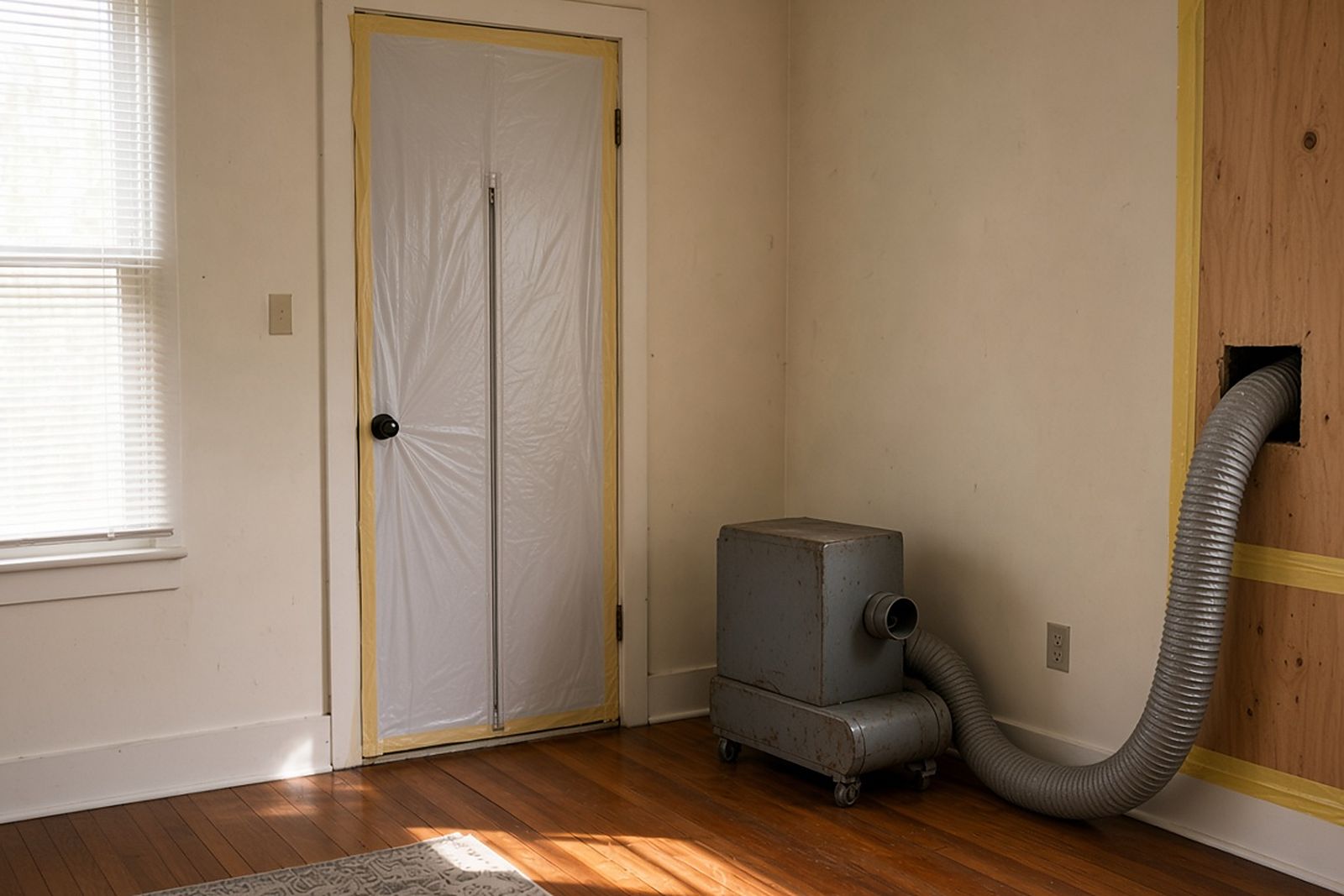
The written plan then sets up containment at the room's entrance so dust and contamination do not reach the rest of the house. Technicians wear double gloves with cut-resistant outer layers, eye protection and fluid-resistant suits, and those cutting out flooring wear fit-tested respirators. Upholstered furniture is wrapped in plastic before it moves through the home, and glass goes into a rigid sharps container.
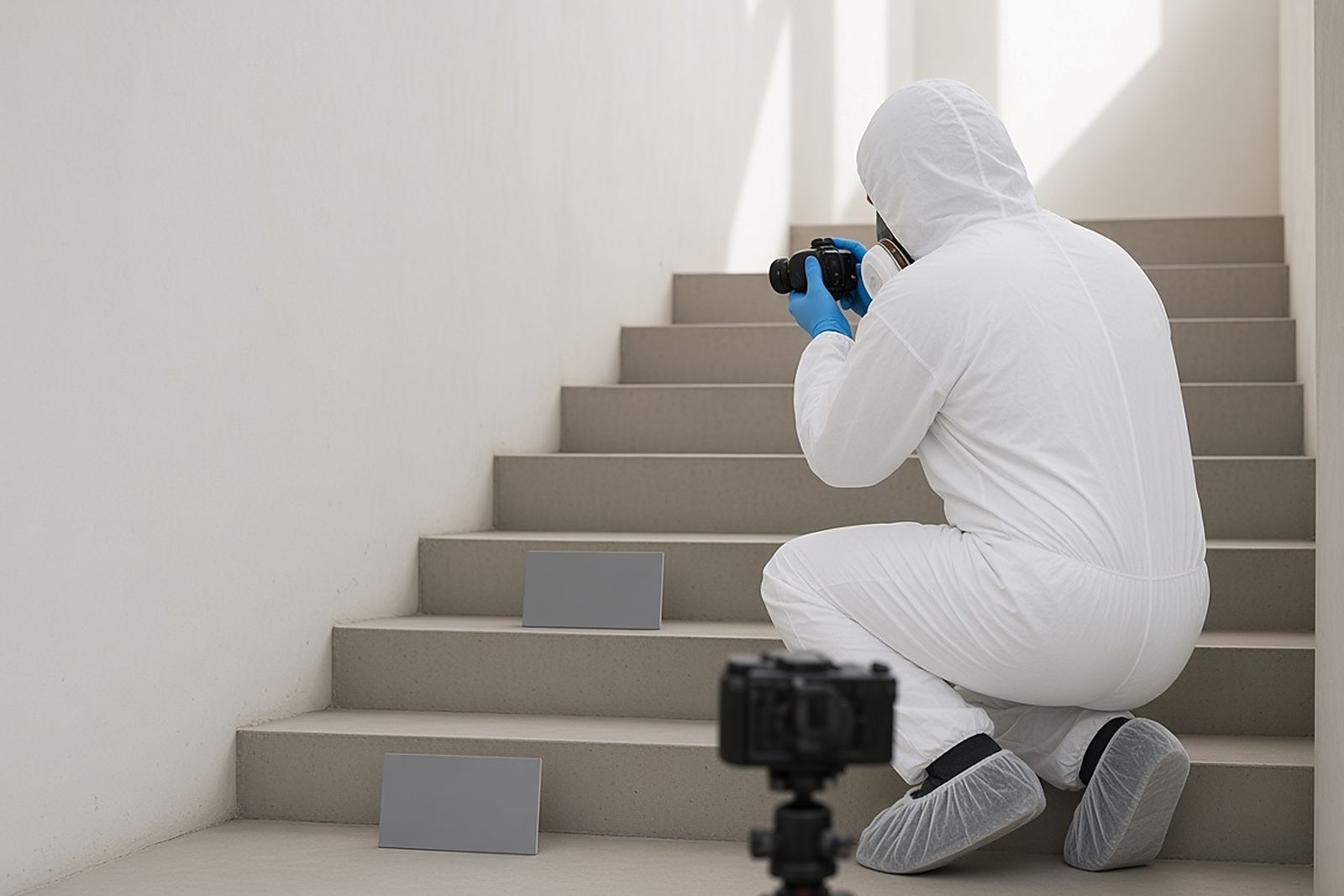
Every item removed is logged and photographed, and regulated waste is labeled before it leaves. At the end, the family or executor receives a written summary with disposal documentation, without ever having to enter the home to know what was done.
Does your state have its own version of these rules?
It might. Federal OSHA shares enforcement with states that run approved programs, and OSHA's 2024 State Plans page lists 29 of them, 22 covering private and public workers and 7 covering only state and local government employees. Where a state plan covers private employers, a state agency inspects cleanup companies and may add requirements beyond the federal minimum.
For a family, the practical effect is modest but worth knowing. A provider that works across state lines should be able to tell you which agency oversees its crews at your address. If it cannot, that uncertainty may extend to other obligations too.
Worker safety is also separate from the rules that govern waste haulers, disposal facilities and any state registration for trauma scene businesses. Each of those sits with a different office, and the provider should be comfortable explaining how it satisfies them.
When a company cuts corners
Workers bear the first risk. Without proper gloves, respirators and sharps handling, they can be exposed to bloodborne diseases and chemical hazards. Without adequate training, they may not know how to remove contaminated gear without spreading it.
Families bear the second risk. A company that ignores safety rules may also skip containment, leave contaminated subflooring in place or dispose of waste improperly. Those shortcuts can mean returning odor, lingering stains or questions from a landlord or buyer later on.
OSHA can cite and penalize employers that violate its standards, but inspections are limited. In practice, the choice you make when hiring is often the most important safeguard.
Questions to ask before you sign
Keep your questions simple. You are not auditing the company. You are listening for a provider who answers directly and without irritation.
If speaking with providers is too much right now, a relative, friend, victim advocate or attorney can make these calls for you. Many families find it helpful to hand this task to someone they trust.
Finally, take care of yourself as the work proceeds. Homicide loss is among the hardest experiences a family can face, and support from a victim advocate, counselor or grief group can make the weeks ahead a little more bearable.
- Is every technician trained in bloodborne pathogens within the past year?
- Do you perform and document a hazard assessment before starting?
- How will you contain the area so the rest of the home stays clean?
- Who wears respirators, and are they fit tested?
- How is regulated waste packaged, transported and documented?
- Will I receive photos, an item log and a written completion report?